

👀🌷📼 Something beautiful is happening with old YouTube videos
Ten hours of rain sounds has 9 million views and the comments will make you cry
New_ Public is proud to support the ATmosphere conference, March 26-29 in Vancouver, BC.
Let’s get right to it this week. Journalist Jessica Furseth brings us an exploration of shared memory-making in the comments of YouTube videos that are often very old and very long. If you liked our newsletter on the indie web, I strongly recommend this one as well.
Also, a quick announcement: we are shifting our format a bit!
As we approach the milestone of having sent 200 newsletters, we are experimenting with using every other newsletter as a community bulletin board. We’ll be sharing links, info, and resources from New_ Public and beyond — stuff we don’t typically have space for alongside our regular excellent, in-depth essays and Q+A’s.
If you have any news or updates for February or March that you’d like to share with our larger community, please drop us a note and we may feature it in the newsletter.
– Josh Kramer, Head of Editorial, New_ Public
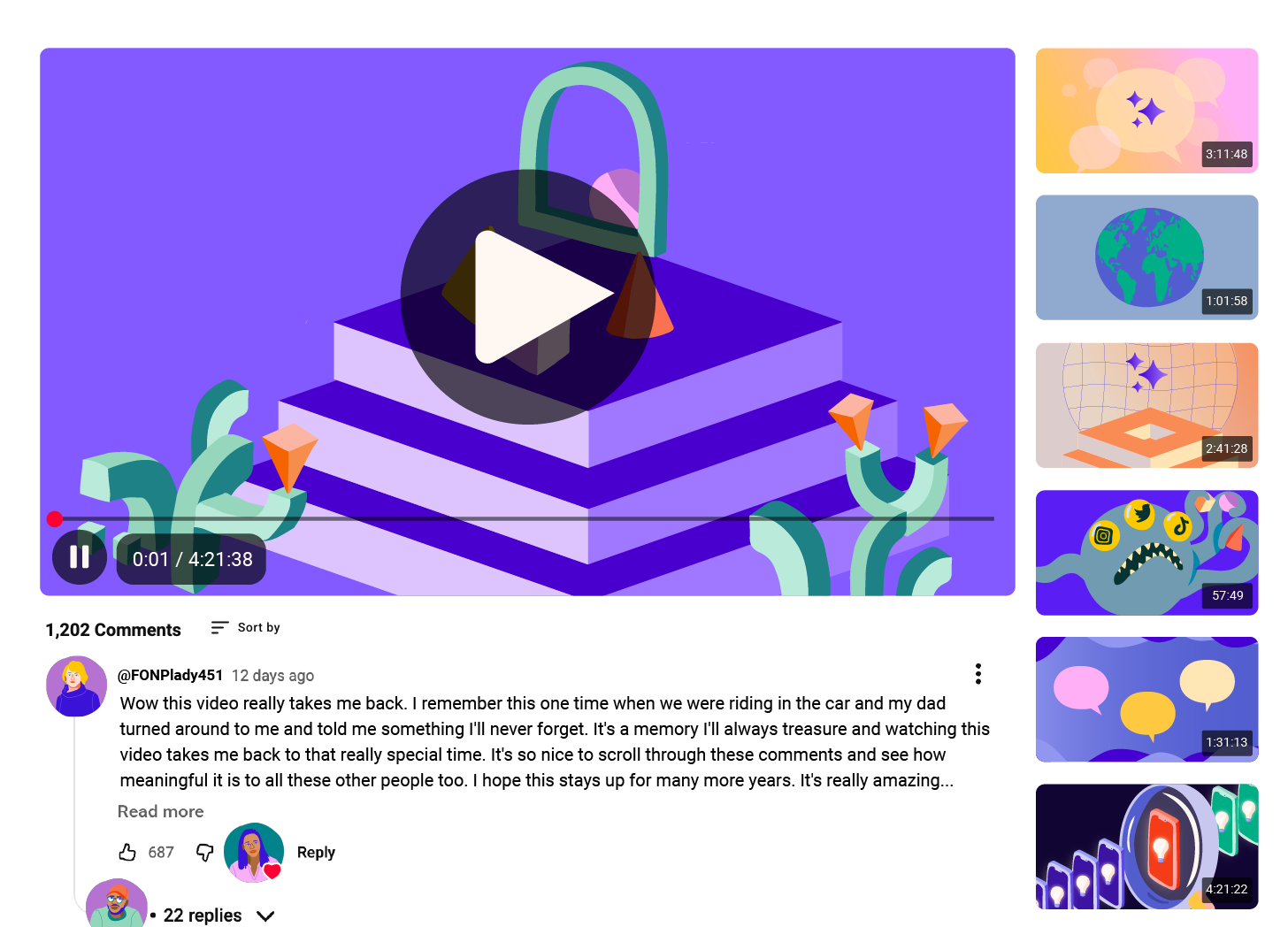
Something wonderful is happening in the depths of YouTube: people keep returning to old videos and sharing heartfelt stories in the comments. Because when nostalgia strikes, we head for the YouTube search bar — and because nothing hits us in the feels like a tune we loved when we were young, we end up in the comments, which are often full of likeminded people, reminiscing together.
YouTube turned 20 years old in 2025 — ancient in internet terms, but the platform can still be evocative, deeply useful, and at times, quite moving. It’s embracing all sorts of new trends, like YouTube Shorts, shortform videos competing with TikTok and Instagram Reels in an online ecosystem increasingly favoring the quick and snappy, as well as video podcasts, livestreams, and membership models. But YouTube is still the undisputed king of longform video, and one of the few social media platforms that’s genuinely searchable. We can return again and again to that old theme song, that comedy bit, that political touchpoint — this is our cultural archive. And since this digital library comes with a comment section, it’s become a receptacle for a lot of reflections, memories, and feelings.
The phenomenon crops up in the strangest of places. There’s a ten-year-old YouTube video of Aphex Twin’s “#19” playing over a snow monkey in a lake which has 13 million views, far exceeding the song’s official music video. The comments are practically poetry:
I’m lying down next to a girl I think I’m falling in love with. She’s asleep and I’m listening on my headphones. Life is good and also weird and also confusing and I’m also unsure. What a trip.
It feels like an online version of a chat between friends in a café, or an artsy community notice board, or even a personal diary. But in the age of “enshittification,” where the offerings from social media platforms are degrading in the hunt for profits, it makes me very nervous to think we’re trusting this offbeat treasure trove to YouTube, owned by Google’s Alphabet, which can and will change anything at any moment.
Preserving a comment thread that’s still going after a decade is certainly not a priority, no matter how magical it may feel to stumble upon it. So where does this phenomenon fit within the complex ecosystem of YouTube? While the platform dynamics keeps trying to nudge our viewing behavior towards the most profitable, what does this organic outpouring of emotion say about what people actually want to find?
What the YouTube machine wants from us
The heartfelt sharing under these videos feels organic and accidental — it would be really hard to recreate it, and it would be an odd strategy even if you could. Growing slowly over time, these stories of love and loss can even feel unrelated to the accompanying video. It would also be hard for the algorithm to distribute them — I came across that snow monkey video on Reddit, and even as I’m playing it, my suggested videos contain nothing else like it.
YouTube is a social media platform that rewards creators in such a way that some of them can actually make a living, but that means creating things preferred by many, many people, and/or the algorithm. This is supposed to be one and the same, according to the official content creation strategy for YouTube Creators: “Our algorithm doesn’t pay attention to videos, it pays attention to viewers. So, rather than trying to make videos that’ll make an algorithm happy, focus on making videos that make your viewers happy.”
Yet the vast majority of YouTube videos get less than a couple hundred views. The algorithm is one of the biggest factors in what actually gets seen by large audiences: YouTube’s CPO said in 2018 that 70% of watch time is directed by algorithmic recommendations. Like all Big Tech algorithms, YouTube prioritizes engagement (views, likes, etc). And because controversy is one of the best drivers for engagement, people are often served increasingly nasty and misleading content simply because it will keep them watching for longer, and not because they went searching for it.
And even when the outcome is benign, the algorithm is far from a neutral force. “By optimizing for engagement, many social media feeds push us towards pieces of culture that are more Western, ambient, empty, cheap, and ephemeral,” New_ Public’s Josh Kramer wrote in a previous newsletter, referencing Kyle Chayka’s book Filterworld. YouTube’s goal is not to broaden our horizons — it’s to keep us watching, so they can show us more ads.
At least among the monetized YouTube channels, the desire to please the algorithm impacts everything from posting schedules and thumbnails to style and editing trends. But the past year’s surge in AI slop has resulted in a departure from fast cuts in favor of more light-touch, limited editing, which feels authentically human in comparison. “Social media users are getting fatigued by the overstimulating, brain-rot style of videos, where graphics and sounds appear every 1.5 seconds,” says influencer marketer Brendan Gahan. “No-edit creators are building deeper relationships with their followers.”
There’s always been plenty of YouTube channels that favor a calmer pace — lots of creators and viewers simply enjoy slower entertainment. My favorite YouTuber, Roaming Wild Rosie, posts just one 40 minute video every two weeks, sharing the progress on the cabin she’s renovating in rural Sweden. Rosie, who’s never posted a single Short, still makes her living primarily from YouTube views and sponsorships. With 300,000 subscribers, her videos have a thriving comment section where people discuss DIY techniques — I’m not a DIYer, but I love following this years-long project, showcasing one woman’s determination to do things her own way, living a life that’s so different from my own.
The push to Shorts is problematic for the slower side of YouTube. Nilay Patel, Editor-in-chief of The Verge, has pointed out that Shorts aren’t as likely to translate into followers, which is how creators make their money. But as Shorts is now more profitable for the platform than traditional content, the pressure will only grow. “I don’t think platforms have thought through what happens when they kill the creators,” warned Patel. If the creators disappear because they can no longer make a living on YouTube, it’s hard to see why we would go to there at all — the creators are what sets YouTube apart.
The unexpected human connection in the comments
So it feels refreshing to stumble upon these story-rich comment sections, which seem to exist in spite of the trends. As we’re increasingly turning to these platforms to fill time, not to connect, social media has become a lot less social — those old videos with vibrant comment sections feel like they fly under the radar, or actively reject new profit-focused trends.
The first comments I saw that made me sit back in awe of the outpouring of emotion were on a video that’s simply ten hours of driving in the rain. We see nothing but dark night and traffic lights, alongside the rhythmic sound of window wipers. The video has nearly 9 million views and beyond the standard pre-roll, there are no ad breaks. It’s become a repository of resurfaced sense memories, mostly of laying in the back of their parents’ cars as children:
I’ll never forget driving to Cornwall with my dad. I opened the window and rain was hitting my head. I used my dad’s jacket and looked into the night. I felt safe and happy. I miss you dad and I love you.
Rave sets are a particularly rich vein of the comment story genre, recalling nights out with friends, simpler times, and dancing until sunrise. Even though the internet is full of anonymous messages, where but in the YouTube comments is it this lovely?
Of course, YouTube, like any platform, also has its share of meanness and shitposting. People are often a lot meaner online than they would ever be in person, but the Online Disinhibition Effect can go both ways — the anonymity of being behind a screen can also prompt people to be more honest and open. It can feel good to share, and adding our own take can make us feel like part of something.
YouTube might actually be changing how we’re encountering and relating to our memories. A 2023 study, which looked specifically at YouTube comments, found that “social media has made instant online access to the recent past a normal part of daily life, making users more prone to expressing nostalgia toward relatively recent experiences.”
It’s hard to know why these comment sections grow to be so meaningful and resonant over time. Perhaps all it takes is one early comment to set the tone and model a graceful and empathic attitude. Or maybe these comment sections feel like safe places for people who grew up on the internet to build memories together. These comments mostly feel like messages in a bottle, left adrift in the hope that the right person will find them.
Despite the algorithm, our desire for connection persists
Nothing lasts forever on the internet. These gentler corners of YouTube may well survive as long as the platform favors engagement, but YouTube has pivoted before, and it will again. The archiving of YouTube comments has already started — Chiara Amisola, an artist from the Philippines, created Thesoundof.love to showcase “the rawness of human intimacy and confession” in the comments left under love songs. Amisola wrote on Instagram that she believes YouTube comments are “one of the last sacred spaces of the internet.”
YouTube will probably always mainly be a commercial, for-profit platform, but it’s lovely to see people using it in unintended ways to create something beautiful. It’s the same desire that fuels the renaissance of the indie web, with its focus on “authentic self-expression, and slow, intentional exploration driven by curiosity and interest,” as Alexandra Ciufudean wrote here.
YouTube is definitely profiting from these unusual uses of its comments, but the real value of this storytelling phenomenon lies elsewhere. It’s a reminder that no matter what the algorithm tries to prompt us to do, many of our human instincts are the same as always: we like to gather over shared interests and tell our stories.
If you want to find some more of these story-rich videos, go to YouTube and search for some songs that were big when you were young. Find a video that’s been up for at least ten years that has a lot of comments — it’s not always the official video. You could try searching for a Nirvana concert video, one of the hits from “Jagged Little Pill”, or the theme song to your favorite show — you may well find your people in the comments.
– Jessica Furseth
(2/11/26: A previous version of this piece mistakenly attributed Chia Amisola’s quote to The New Yorker, instead of her Instagram post.)
Thanks Jessica!
Soaking up sun in Honduras this week,
–Josh
 | A guest post by
|
Thank you for this piece. I think YouTube and other social media platforms do serve as genuinely amazing creative outlets and memory archives that we keep going back to in search of who we are, how we can be different, who we want to be like and with. I hope we can preserve the best of it and truly make it safe and welcoming for all to enjoy.
Hi Jessica!
I totally get it. I have found myself seeking out ambient jungle sounds or chimes, some of which had that beauty you described in the comment section.
Another beautiful – in a totally different way – thing unfolding on YouTube is how investigation itself is becoming public again. Podcasters working alongside their audiences, are collaboratively questioning narratives, tracing evidence, and comparing notes in the open. A lot of the action and collaboration is also happening in the comments. The YouTube comments are much more congenial than on X.
It’s messy, imperfect, but alive. A kind of open-source investigation that doesn’t wait for institutions to tell it what’s allowed to be seen. Reality collapse and narrative control is dissipating on the screen and in the comment section.
The movement is being called the Decentralized Intelligence Agency as coined by Candace Owens. Many of the De-CIA are pouring through the E files and still tracking down lies around the Charlie Kirk assassination. None of them believe the Trump administration's lone gunman story.
This, too, feels like something new and worthwhile taking shape.