

Of all the people to introduce to our new residents, in our Entrepreneur in Residence pilot program, Ben Werdmuller is at the top of the list.
Ben, a great friend of New_ Public, is a writer, founder, investor, and tech builder. He sits at the intersection of many New_ Public focus areas, including information ecosystems, prosocial technology, and the open social web.
Starting with a meme site decades ago, Ben has built a lot of social technology, including an open source social network for education used by governments around the world. In journalism, Ben served as CTO for The 19th, and most recently, Ben was Senior Director of Technology at ProPublica. He is now a JSK Journalism Fellow at Stanford.
As we welcome these residents into the pilot (more on them next time), I think that Ben’s expert perspective about what to prioritize is useful for them and everyone who cares about building a healthier, saner, more human internet.
–Josh Kramer, Head of Editorial, New_ Public
In a varied career, how Ben decides what projects to work on:
It took me a little while to encode what my values actually were. I realized that what I really care about is building technology that has the potential to make the world more informed and equal.
And the result of that was finding my way into the news industry. I didn’t start there, but in the current era, where a lot of technology is about consolidating power, wealth, and who can be the source of information, it felt like working directly alongside — and then directly in — journalism was a way to kind of counteract that, to build a more equitable society or be helpful in doing that.
It’s not perfect, right? There are definitely trade-offs. I built that first open source social network at the same time that Mark Zuckerberg was building Facebook. He has a private island, and I don’t. But I’m okay with that. Mark Zuckerberg built a platform that I think was culpable in facilitating a genocide. I didn’t. I’d rather be on the “I didn’t” side of that equation.
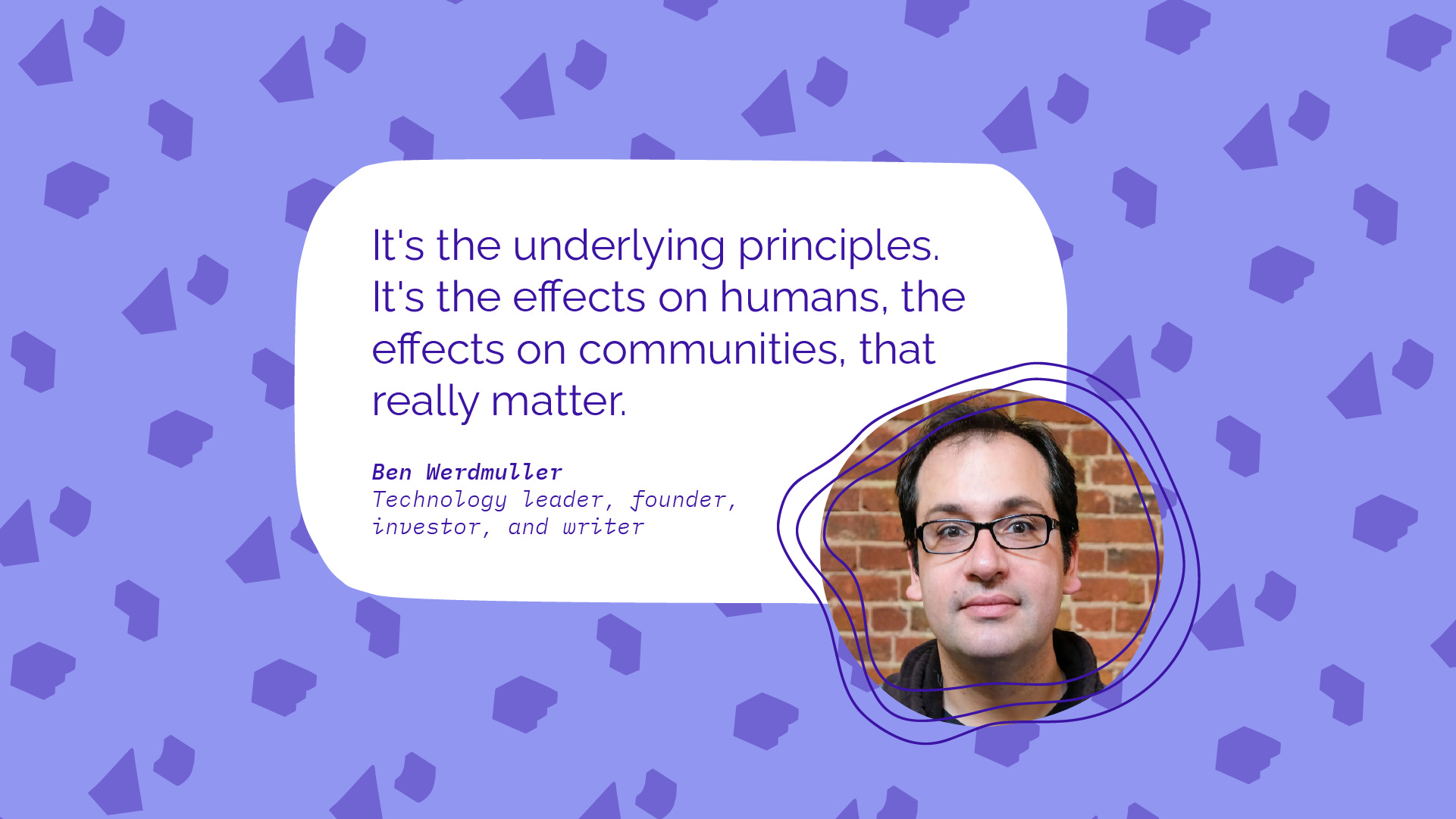
In any company, you want to create a mission, vision, and strategy. I think it’s really helpful for individuals to do that as well so that they can be really, really clear about what they want to work on and what they don’t want to work on. Like at no point have I said, “I want to work on journalism, I want to work on social networks.” It’s the underlying principles. It’s the effects on humans, the effects on communities, that really matter.
How Ben came to these three questions for anyone looking to start a platform … Who specifically do we want to help? Why are we the right team to help them? How can we address their needs better than anybody else?
Those questions are actually rooted in design thinking a little bit. As a technologist, I think the default for a lot of engineers is to just kind of go, “I’m going to build something cool, and it’s based on an idea that I have, or I’m going to try and solve this thing I see in the world, but I’m going to do it in a vacuum, effectively at my desk.”
And one of the principles of product design is really to go out and figure out: Who are the people that you are trying to help? Because the other fallacy is that people will say, “this is for everyone,” and, in doing so, they build a product that’s useful for nobody because they don’t have a really strong sense of what people’s needs actually are. There’s no defined user.
They’ve got to find a defined user, talk to them, figure out what their problems are — which requires knowing them holistically. They need to understand their lives, who they are as people, and then really confront questions like, “am I the right person to do this?” All of that is really important if you’re going to build any kind of equitable solution.
This is partially informed by my second startup and working for an accelerator and leading their investments in San Francisco. I was constantly working with all of these different mission-driven groups and learned a lot about the dynamics of what makes a team successful. And it really does come down to, “are they going to try and be the smartest people in the room and just hold on to their idea, or are they going to be constantly testing their assumptions and adjusting based on the needs of the people they’re trying to solve for?” And, obviously, that latter group is much more likely to be successful.
Particularly for engineers who might be just thinking that they can build a technical solution for a social problem, I think it sets up a line of inquiry that’s hopefully useful.
Some of the biggest threats and opportunities for local journalism in this era:
The threat to local journalism is that none of them have any money — let’s be clear about that. I think we all know what’s happening in terms of Google Zero and social media referrals. It’s hard for them to be discovered, to make revenue, and for people to even share and learn about those stories. And now with AI, we’re seeing a new level of intermediation where that threatens to, again, squeeze them out of the equation. That’s one threat.
There’s actually another threat which is that nonprofit media funders are now talking about picking winners and consolidating rather than embracing a long tail of projects and newsrooms. These local newsrooms may not be on the radar of these larger institutions, which may miss why they’re important.
The opportunity is to really serve communities on a deeper level than they’ve been served before with news, information, and community itself. I’m on the board of Tiny News Collective, which is a nonprofit that supports representative, local newsrooms. It’s been wonderful to see these often very small operations that are deeply connected to their community. They know their audience intimately as human beings and can therefore serve them both with information that they need to have a great quality of life and be a voice for them on a larger media stage.
What’s fascinating to see is those local newsrooms that have bucked the trend when it comes to trust. They are more trusted because they represent their audience, they are building community, and they are building relationships. Meanwhile, those larger national newsrooms or international newsrooms are losing trust by being so abstracted away and not representing them as clearly.
You often will see small newsrooms that have been around for decades, that are essentially supported by one person. And that one person, more than anything else, has been like a community convener. What they’re building is relationships.
But you also see these newer outlets that are very web-first. They are more incentivized to experiment than maybe some of the larger incumbent newsrooms. They have this whole opportunity to really actually change and disrupt in the true Clayton Christensen sense of what a newsroom can be, right? They have a lot to play with, to just explore the form and figure out how they can better serve their communities.
New_ Public is floating around there also, thinking about how Roundabout can serve communities too. I think that’s where the biggest opportunity for news is — those local and highly focused spaces.
The limitations and promise of using AI to create new social technology:
The tools that let people create new platforms and new experiences that support their work are largely unwritten. We are at the beginning stages, but I do think there’s a lot of potential.
One of the things that I plan to explore is small community spaces. You can imagine spinning those up with AI. You plug in: “Here are my requirements, here’s who I’m trying to serve, here’s what I’m thinking about,” and it actually creates a time-limited community space based on the open protocols that we have around social networking, based on building blocks that we pre-define. There’s no coding involved in that, and it’s surprisingly similar to how older platforms like Ning started up. I think there’s a lot of potential for those kinds of experiences.
What is happening right now is that organizations are experimenting with AI, and they’re actually getting themselves into a lot of trouble because there are very few guardrails. It’s really easy for folks to build underperforming or unsafe software and then not have anybody to ask for help with it.
I don’t think someone is going to come along right now with Claude Code and build a whole custom platform for themselves unless they also happen to be a senior engineer. I think there will come a time, over the next year or two, where you are going to be able to construct your own stuff, armed with open standards, both around code components, protocols, and rules of interaction between systems. I think you are going to be able to construct pretty bespoke sort of experiences, but those things are startups or movements in themselves.
I think at the same time, we are going to see the thesis of “After the Feed,” which is that you are going to see more intermediation and AI actually making our existing platforms much, much worse. And so, the ability to create these small community spaces in particular is going to be really important as people retreat into social networks versus social media. I think people can use AI to help make more bespoke spaces for small, particular moments. Because you cannot have one-size-fits-all experiences; you need software that actually supports diverse communities well. So AI is creating the terrible situation we want to get out of, but it may also be part of the solution.
The argument for the open social web:
The open social web is a vision for the internet where everybody can learn from each other, communicate, share, and represent themselves on their own terms, such that no central entity has the power to affect the way we connect with each other, the information we learn about and so on.
So if I say, “Oh, I want to share this with Josh,” I don’t have to worry about whether Elon Musk will let me because Josh is on one platform and I’m on another. I don’t have to worry that Elon Musk making a decision will change the way I communicate with my friends.
I will go so far as to say that I think the open social web has the potential to be as expressive and diverse as the web itself, with the added benefit that it also encapsulates our relationships, our communities, our interests, and our identities. I think there are a lot of unanswered questions. It’s not always obvious that openness is valuable. When you make everything open, you also make everything open to surveillance. If you are open about your identity and your discussions, that can be very harmful for certain vulnerable groups.
We have to make sure that we are paying very close attention to the safety of communities. Otherwise, we wind up in the same place. The potential and the real promise of the open social web is that we can all do this on our own terms. We’re free of that intermediation, exploitation, and manipulation.
This isn’t actually about technology. It’s not about protocols. It’s not about the source code of social media. Those things are obviously in the mix. But what really matters are the actual social contracts, the human understanding, the community dynamics, the power dynamics. And so finding ways to be open and really embrace people who are not software developers, people who are not engineers, people who come from a wide array of disciplines to come in and help build this together — that is how we’re going to get to the real promise of this. If we are limiting ourselves or prioritizing the code, then we’re never ever going to really break out of the problems we find ourselves in.
Thanks Ben!
Off to our retreat in one of my favorite places, Philadelphia,
–Josh
Anyone from New Public able to speak to high school seniors researching about AI usage and a positive vision for the future? In person would be best (we're in Pittsburgh) but we can certainly go through Meet as well. There are at least 5 seniors across three AI and Ethics classes that chose a core research question about AI sustainability or implementation and where it can be beneficial, which fits your mission 100%