

Meta has been saying for years that making its social media apps meaningfully safer and less toxic would break their products. And yet, when facing almost all of the states’ Attorneys General, they agreed to a suite of new features and settings for teens.
Maybe this stuff is far more plastic and changeable than we all thought. So why should the companies get to decide how you experience these apps?
We find ourselves in a moment where increasingly there are new options for customizing “the algorithm.” This is what we’ve been saying: open web protocols and AI-powered tools are making a ton of new, exciting research and innovation possible.
Case in point: Jonathan Stray, a senior scientist at UC Berkeley’s Center for Human-Compatible AI, and Renée DiResta, Associate Research Professor at Georgetown’s McCourt School of Public Policy, have a new tool that lets you see inside your own feed and change it like never before. This is the culmination of years of work on the Prosocial Ranking Challenge and elsewhere.
Below, Jonathan and Renée take you into MySky, which you can try out for yourself by logging in with any Bluesky account!
For more, Jonathan will be on a panel with our friends at the Council of Tech and Social Cohesion and the Neely Center this upcoming Tuesday, September 22, 12:00pm to 1:30pm ET.
–Josh Kramer, Head of Editorial, New_ Public

One thing is remarkably consistent across social media: the platform decides what you see.
Facebook, TikTok, X, Instagram — you can follow people, mute them, swipe, like, block, and occasionally choose between a couple of feed modes, such as “following” or “favorites” on Instagram. But there’s tremendous power in default settings.
The machinery that actually assembles your information environment is mostly out of reach. You cannot usually inspect its priorities, change them, or ask the app why it made a particular decision. If you don’t like something, well … you can give the machine signals and hope it takes the hint.
Recommendation algorithms make choices about whose voices receive attention, which subjects dominate a conversation, what kinds of behavior get rewarded, and what each of us comes to understand as important. In other words, they perform some of the basic functions that shape a public sphere.
So what would it mean to give people real control over those algorithms?
That’s the question we’ve been asking for a long time now, in research and in public commentary, and it’s why we’ve built MySky: a modern algorithmic feed with a full set of user controls — a panel that shows you the whole pipeline, top to bottom, exactly as it runs. We now have more than 60,000 daily active users, and we’re just getting started.
The point is not that we’ve discovered the most correct set of values for an algorithm. It’s that there is no value-free algorithm in the first place.
MySky currently runs on Bluesky by way of AT Protocol, the technology underneath, but the larger goal is not to create a particular feed on a single platform. We’re envisioning expanding MySky to other platforms as well, to ensure we reach diverse user communities. This test aims to create a different relationship between people and the algorithms that mediate their attention.
Dialing in your algorithm to match your values
Most recommendation systems work in three stages: First, the system finds a pool of possible posts. Then it ranks those posts according to some definition of value. In many cases, Big Tech social media algorithms are often optimized for engagement, which is closely tied to the platforms’ business models. Finally, the system makes adjustments — for example, preventing the same person or topic from taking over the entire feed.
These choices are normally buried deep inside a platform’s logic. In MySky, they are visible to you in a settings panel.
We’ve tried to be as transparent as possible, and to give users as much agency as possible. Open the controls by clicking the link at the top of your MySky feed, and you’ll see the three classic recommender algorithm stages, laid out in order.
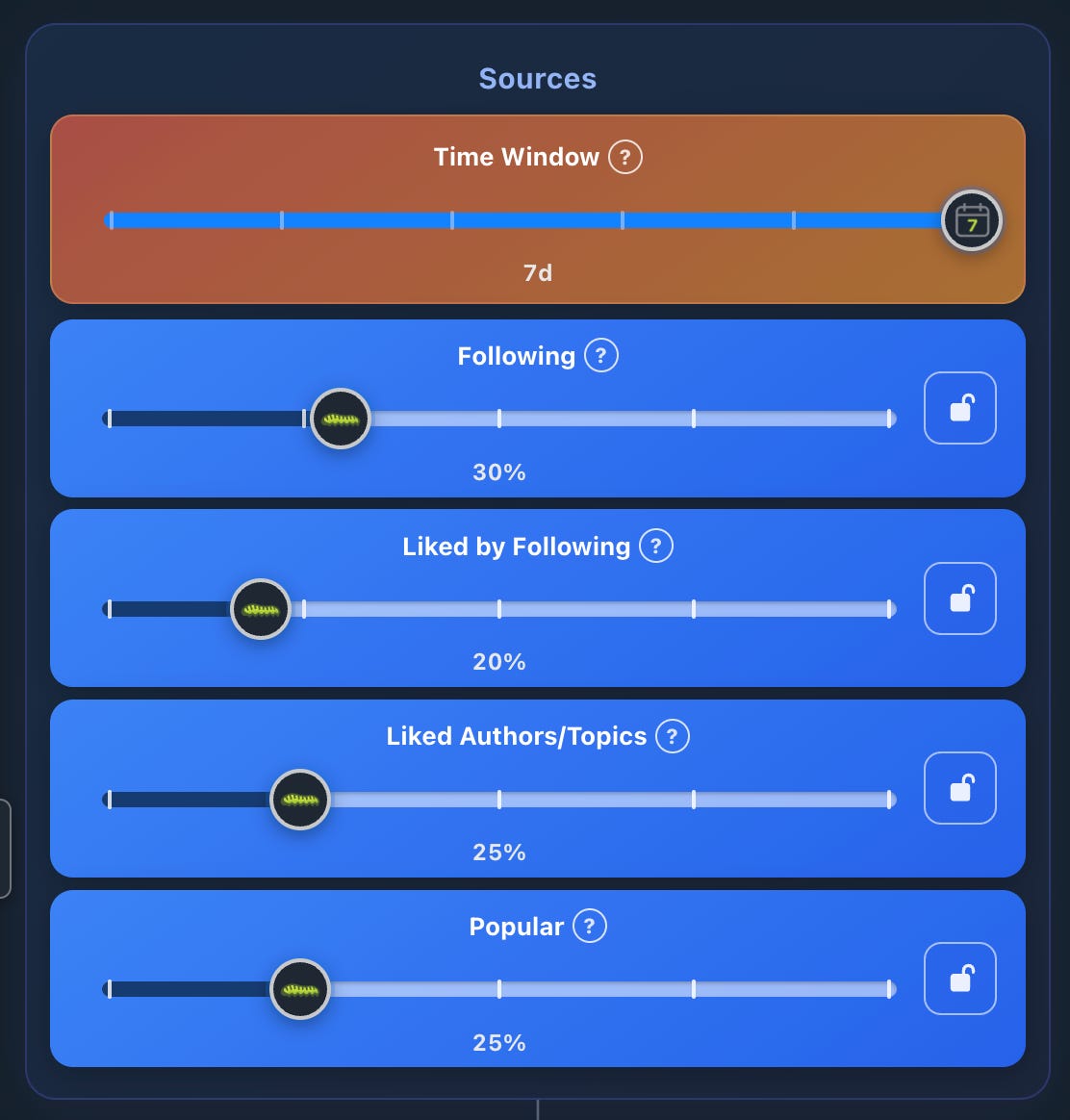
Sources: Where should your feed look for material? Its job is to select a few dozen — hopefully good — posts out of millions of potential items. MySky can draw from people you follow, posts that those people liked, authors and subjects you have shown interest in before, and popular posts from across the network. You can decide how to weigh each.
Notably, increasing the influence of one factor decreases the others — you need to prioritize which factors are most important to you. You can also set the time window, from seeing only the freshest posts from the last few hours, or across a whole week to catch up on evergreen bangers.
The larger principle underneath these settings is that the composition of your information environment should not be a platform secret. You should control it.
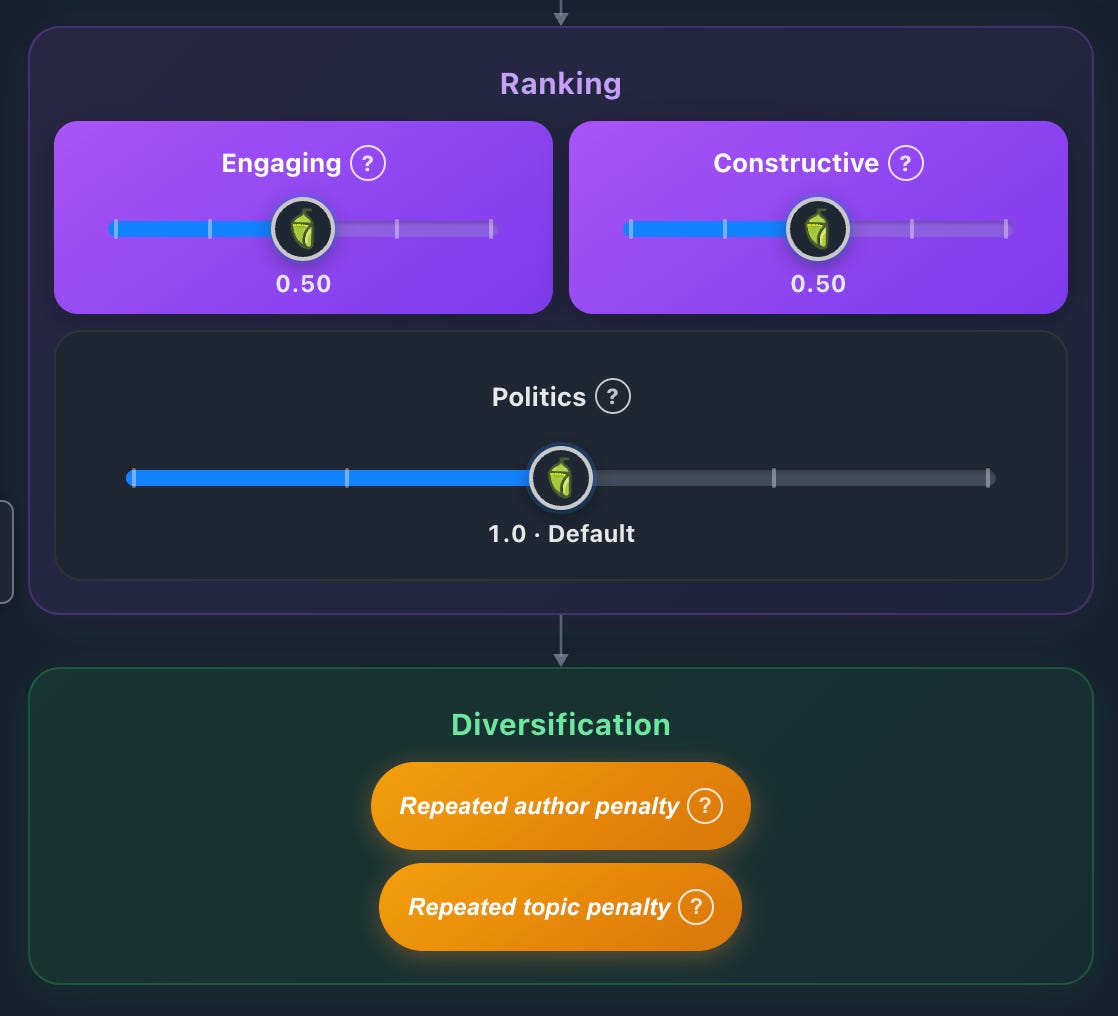
Ranking: Once potential posts are collected, each post is scored in two ways: engagement (how likely you are to like, share, or comment on it) and how constructive it is.
Engagement is a key signal for every recommender system used by a Big Tech company today. Systems that relentlessly optimize for engagement can amplify outrage, clickbait, and falsehoods. Yet purely chronological feeds are not an ideal solution either: whoever posts most often gets to be the loudest, it’s difficult to discover interesting people outside of your network, and experiments with Facebook and Instagram actually found that chronological feeds increased the amount of untrustworthy content.
Hence some sort of algorithmic feed, including some consideration of engagement in content ranking, is essential to creating a good user experience. Without trying to figure out what you will “like,” the algorithm cannot adjust to your taste.
But engagement is not the only goal. We also score each post on how “constructive” it is. This is not a synonym for politeness! Passion and even anger can be constructive. What matters is whether a post contains features such as reasoned argument, personal experience, curiosity, respect, or a genuine attempt to communicate across difference.
Here’s a detailed description of how we classify the “constructiveness” of posts. This is what’s known as “bridging” — and in academic research, prior experiments we’ve conducted have shown that bridging feeds can actually improve relationships between people who disagree.
In the MySky feed, engagement and constructiveness are weighted equally by default. But that default is neither opaque, nor locked in. You can turn constructiveness down and get something closer to a conventional engagement-ranked feed. Or you can turn engagement down and ask the system to rank principally on qualities in the content itself.
Diversification: Finally, we apply penalties for repeated authors and repeated topics. This prevents one loud account or an exhausting news cycle from eating your entire feed. Soon, you will be able to adjust these weights if you want to see even more diversity or a narrower focus.
Every feed is already making choices about selection, engagement, and diversification. We would rather make those choices transparent and changeable by the user. You deserve to have agency over your experience. You deserve to understand why your feed is constructed in the way that it is.
Open Source and Open Science
MySky supports three different types of transparency: live explanations, open source code, and open science.
One of the central questions of algorithmic life is “Why am I seeing this?” Usually, the answer available to a user is something like: because the system thinks you will find it relevant.
That is not much of an explanation. A useful explanation should expose enough of the decisions behind what is served up by the feed that a person without a technical background can understand it — and, ideally, do something about it.
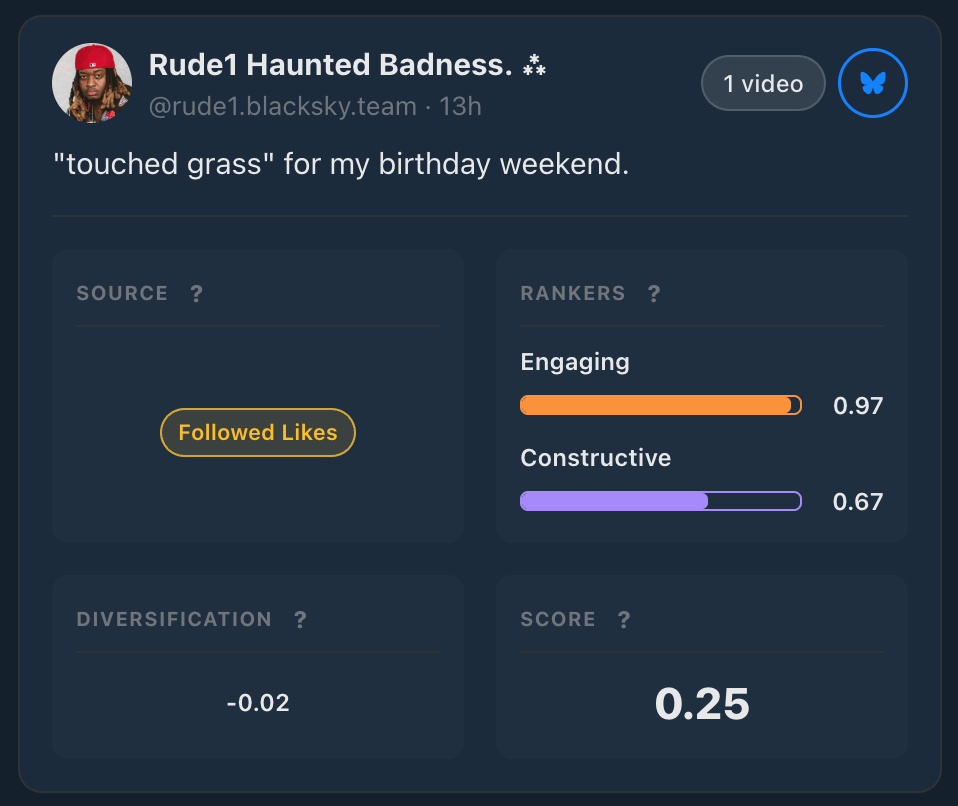
For any post in MySky, you can open a “Why Am I Seeing This?” panel. It shows where the post came from and how the different ranking and diversity components contributed to its position in your feed.
MySky is also open source, so you can inspect the algorithm for yourself. You can even join our Discord, where you can meet our team and chat with us about the project.
Motivated builders can run the entire stack themselves. However, to run MySky we pay thousands of dollars a month for servers to index the entire ATmosphere (all ATProto content), and we’re happy to take that on (if you’re a philanthropist or tech donor, we’d love to talk). We instead encourage experimentation through our API. Rather than a fixed feed algorithm, it’s a flexible system of search indices, candidate generators, and rankers that you can customize to your specific application.
We know that very few people are going to read thousands of lines of recommender-system code, understand how they interact, and calculate what those choices mean. Meaningful transparency therefore has to operate at several levels.
The code should be inspectable. The system’s decisions should be explainable. And ordinary users should have controls that correspond to things they actually care about. There is also a fourth kind of openness we think matters: open science.
MySky is designed for open science. If we want to understand the effects of platforms on people, we have to study real people using real platforms. Otherwise, algorithm design and policy-making happens in the dark. Commercial platforms constantly run experiments on their users but they don’t tell them they are being studied or share the results publicly.
Because the effects of feed algorithms are complex, we want to run experiments too, but with consent. How can we make these algorithms less addictive and polarizing, and more informative and overall better for your well-being? There is precious little high-quality public knowledge on these questions and theory only goes so far; the only way to know for sure is to try things out.
That’s why MySky is also a platform for open research, where researchers can study questions such as, “Can a feed be engaging without being addictive?” We will invite members of the ATProto community to participate in experiment design and analysis, and our results will ultimately be published in open-access journals. When we collect expensive survey data, we will train privacy-preserving open models to make future experiments cheaper and easier.
What would you ask your algorithm to do?
We are rapidly developing MySky and many features are coming soon. Sliders are just the beginning! We’re currently working on infrastructure to let you describe your ideal feed in your own words: “more local news, less sports,” or “keep the politics but drop the outrage.” The idea is to turn prompts in plain English into functional controls. Type a description of a type of content you want to see more (or less) of, and it will instantly create a new slider in your settings.
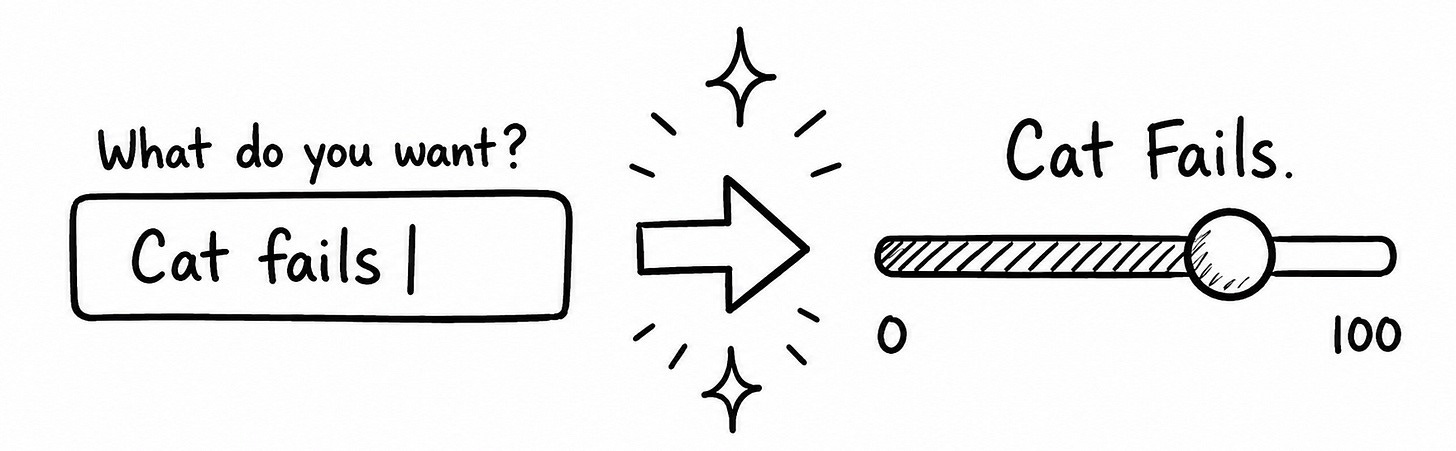
The open social web has already begun separating social technology from the companies that have owned and operated these platforms for decades. Protocols like ATProto and ActivityPub make it possible for different applications to interoperate over shared social infrastructure. We think algorithms should become separable too.
We want the MySky algorithms to serve you. Try the feed. Move the sliders. Break something and tell us. Transparent, controllable, state-of-the-art social media algorithms have been a long time coming, and we’re building them for you.
–Jonathan Stray and Renée DiResta
Thanks Jonathan and Renée!
Heading out of town to spend the weekend on a houseboat,
–Josh
I love this. This is absolutely the way ahead. Censorship does not work, and giving unaccountable organizations power over what you are “served” does not work either. Self-curation is the logical next step in the evolution of this still-nascent technology.
Love this idea of a user-customizable feed - removing the secrecy of the algo puts power in the hands of the users. That said, good solution but maybe just a band-aid. I'm still not entirely sure about social media as a whole. Do that many randos have something interesting that I want to read?
Put more sarcastically: This is GREAT! Now I can see the breakfast photos of only the people I like!