

👋 Introducing Roundabout: built for neighbors, with neighbors
New_ Public’s app for local communities enters closed beta in five pilot communities
Last June, our Co-Director Eli Pariser laid out a bold new direction for New_ Public in this newsletter:
You may not think of this as social media, but most towns in America have some sort of general-purpose, locals-only digital forum: a Facebook group, a Google group, a Nextdoor neighborhood. These groups mostly run below the radar — they seem quotidian, maybe even boring. But according to Pew, “about half of US adults say they get their local news from online groups or forums,” more even than from newspapers. If they were strengthened into resilient, flourishing spaces, they could be crucial to reinforcing American democracy. That’s why we’re going to make them a major focus of our work at New_ Public.
Since then, we’ve deeply explored local digital spaces, including Front Porch Forum’s inspiring example of what’s possible, and grim reminders of how the status quo is not sufficient with platforms like Nextdoor.
Most recently, our Co-Founder Talia Stroud helped us field a national survey on these spaces, along with the Center for Media Engagement at the University of Texas at Austin. You can watch Talia present the data, or review the deck.
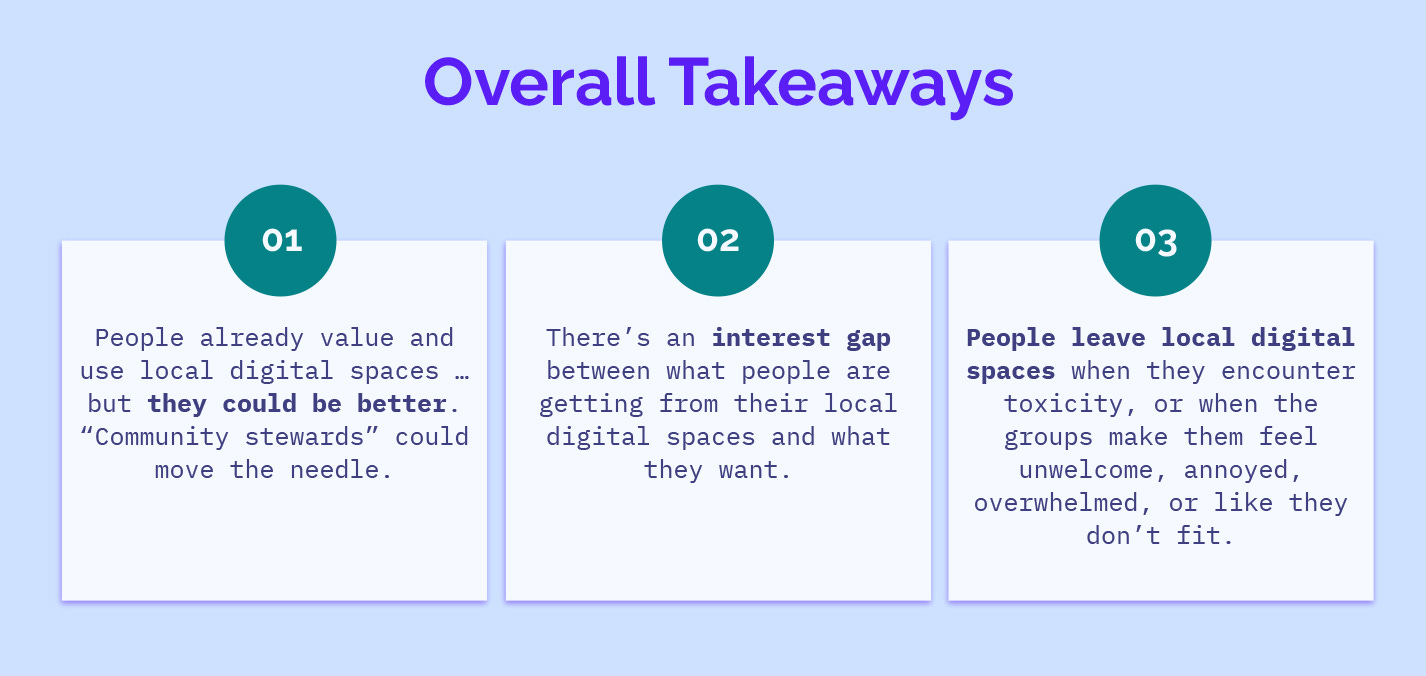
Through this research, some of the best data on local digital spaces available, Talia found a key opportunity: many people use these groups, but they could be so much better. There’s a significant interest gap between how people actually use these spaces — for finding recommendations, for example — and how much they would like to. Stewardship also makes a difference. This is everything we’ve been building towards.
We’ve been assembling a team, with both talented leadership and skilled expertise, and building a new tech product in-house. We’re thrilled to announce that this is all coming together in New_ Public’s new web app for local communities, which is now entering private beta testing in five pilot communities throughout the United States.
Introducing…
The main thing to know, maybe the most important thing, is that this is not just another social media app. Roundabout is a community space, built from the ground up with community leaders and neighbors.
We’re so excited to share more about Roundabout in the coming months, and we’re determined to grow and learn in public, along with you. Here’s a preview:
Roundabout is for building real relationships with people who actually live, work, and play in your community through trusted information sharing, genuine conversations, and mutual support, not posts competing for likes and virality.
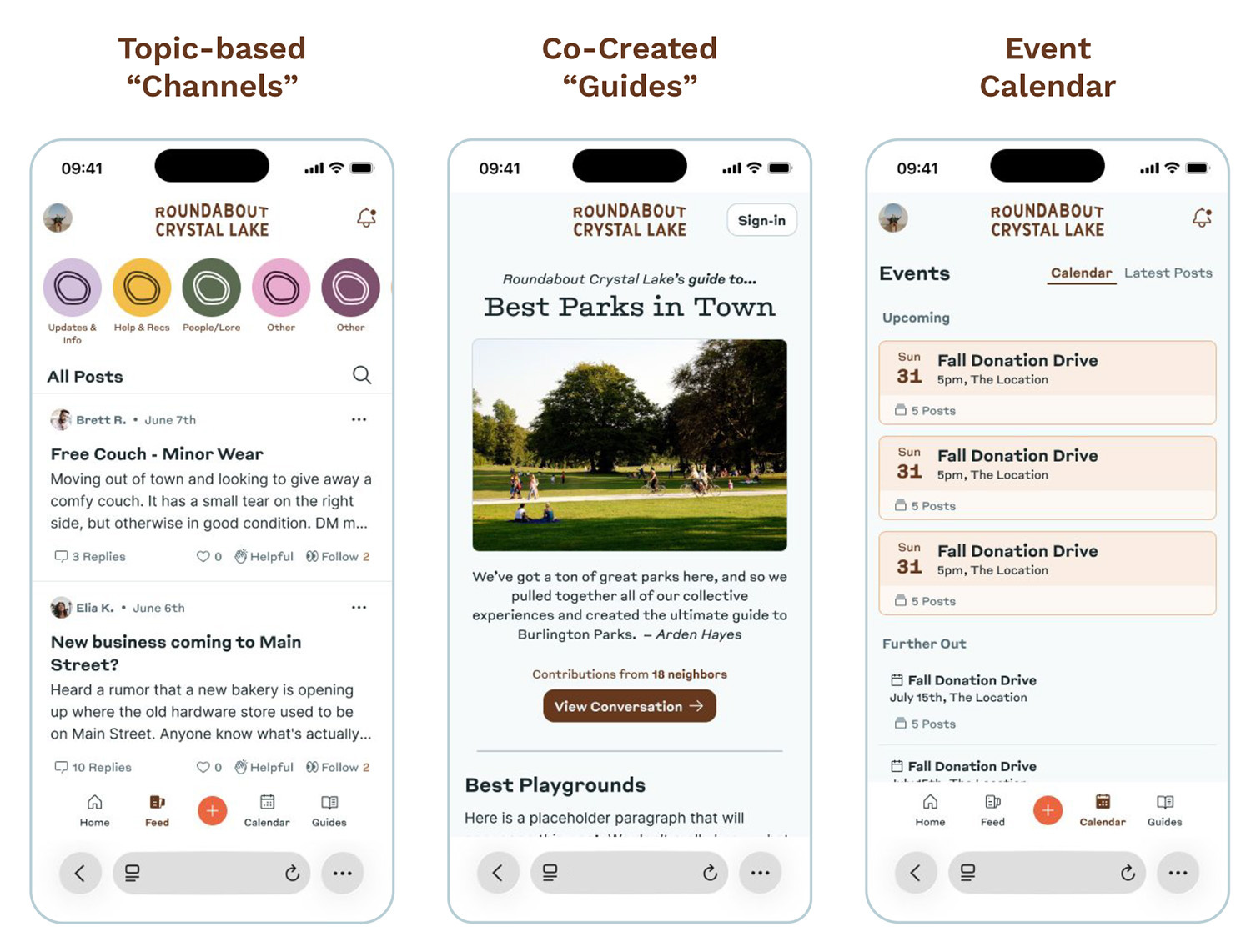
Users can quickly find what they’re looking for via content that’s organized into topic-based channels, with a separate calendar to find events and a Guides section to find more evergreen resources.
Local stewards are supported and empowered. Each community will have its own vibes and culture.
The big platforms, some several decades old now, were built for profit — every decision, every design, optimized for uncontrolled growth and extraction. We’re doing something different.
As a project incubated within New_ Public, a nonprofit, Roundabout will grow incrementally, sustained by a diverse and balanced set of revenue sources. With business incentives aligned towards utility and everyday value, instead of engagement and relentless scale, we’re designing Roundabout to be shielded from the cycle of enshittification. The ultimate goal is to build for social trust — every decision, every design, optimized to build bonds and increase belonging.
We will need your help to get this right. Down the line, we will be looking for stewards to reach many, many more communities around the country. If you want to bring an independent, people-powered digital space to your own town or neighborhood, you can join the waitlist here.
Below, Hays Witt, Head of Community Engagement for Local Lab Roundabout, will introduce you to our pilot communities and the first cohort of Roundabout stewards.
– Josh Kramer, Head of Editorial, New_ Public
Technology that connects us
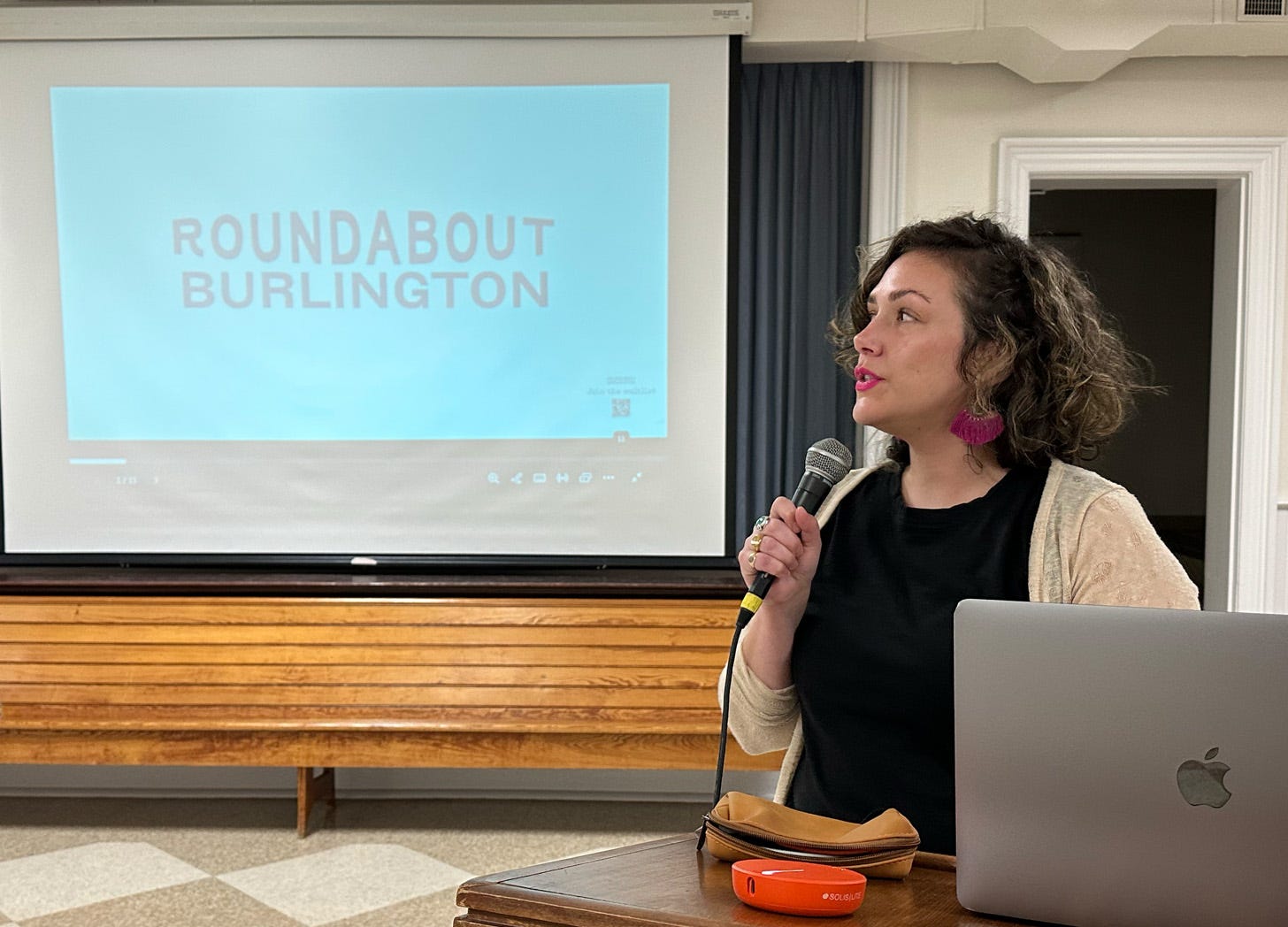
In the basement of a historic church in Burlington, North Carolina, Katie-Beth, a third-generation resident and small-business owner, is deep in a discussion about community information needs with a group of neighbors, friends, and community leaders, including the small town’s recently elected mayor.
She shares her take on the state of human connection on the internet: “At first it was amazing to be able to find people like you anywhere in the world. Then we got so wrapped up in the internet that we lost touch with our neighbors. Now, it’s time to build technology that connects us where our feet are.”
Heads nod, and a robust discussion ensues about how Roundabout, the new online community platform we’re building together, could help people in Burlington have a central place to talk about the rapid demographic and economic change happening in their community, while lifting up all the positive events happening there.
Katie-Beth invited me to join the meeting as part of my team’s work supporting community stewards who are piloting the Roundabout platform in five communities around the country. These aren’t just beta testers — they’re community builders who know their neighbors and understand what their hometowns need. In addition to Katie-Beth, here is the rest of the first cohort of Roundabout stewards:
Sam and Liza describe Roundabout Richmond as “an app for reality” that helps people connect to their real life community, while being a central source of information with great design. As partners running Ours, a popular community gathering space in central Richmond, Virginia, Sam and Liza hold a unique perspective on what it takes to bring people together amidst Richmond’s challenges with rapid growth, gentrification, and strained infrastructure.
Kyle is a librarian and parks and rec commissioner in rural Lincoln County, Wisconsin. He’s collaborating with a group of county residents who want a better source of information about local government, as well as a new place for community members to share their perspectives and opinions. In addition to civic info, Roundabout Lincoln County members plan on sharing stories about everything from local history, to disc golf, to high school sports, to hunting.
Logan is the creator of Chattynooga, a weekly newsletter that shares local events, news, and cultural happenings. Logan started Chattynooga after experiencing how difficult it is to make meaningful connections in this age of remote work and hyper-online life. He’s launching Roundabout in North Chattanooga, Tennessee, a quickly-changing area that ranges from urban to semi-rural, with lots of young families.
Suzi is a lieutenant in her volunteer fire company and a world-class field hockey umpire. Those roles have honed her skills in crisis response, clear communication, and fair facilitation — exactly what’s needed to steward Roundabout Conestoga Valley. Set in the greater Lancaster, Pennsylvania region, Conestoga Valley spans urban, suburban, and rural areas. Suzi’s deep, faith-based commitment to community service makes her well-suited to help this diverse area find common ground online.
Building the Launchpad
Katie-Beth, Sam, Liza, Logan, Kyle, and Suzi were among hundreds of people who responded to an open call for pilot locations that we shared through our networks, as well as via trusted partners like the Steinman Institute for Civic Engagement, NC Local, and the Trust for Civic Life. As we sorted through the pool of applicants, we were looking for great combinations of:
People who had a strong vision for what Roundabout could be, an excitement to work through the twists and turns involved in building new technology, and a track record of bringing people together in their community, and;
Places that, taken together, had a high degree of ideological, demographic, and/or economic diversity, and both strong positive community dynamics and significant challenges to work through.
For the last three months, these stewards and our team have been meeting three times a week, building collective knowledge on topics like community listening, content strategy, moderation, and growing membership. Along the way we’ve collected crucial feedback on product and feature prototypes, ensuring that even the first versions of Roundabout — highly subject to change — will directly meet community needs.
Learning about community needs together
We selected a highly-varied group of communities in order to ensure that what we’re building is universally relevant and useful. These towns and neighborhoods don’t necessarily represent every type of community in America, but they have a broad range of traditions, geographies, value-systems, and more. While each community has really specific needs, cultures, and priorities for Roundabout, we are starting to see some emerging patterns:
Filling news and information Gaps
All five communities have identified critical gaps in their local information landscape — often fueled by the decline of their local news ecosystem.
Kyle watched his local newspaper in Lincoln County fail to adequately cover big issues around public infrastructure or provide citizens a platform to voice concerns. Whereas Sam and Liza say there is “no source of truth” as Richmond undergoes major shifts.
Suzi thinks Roundabout will help play the role local media once played in Lancaster, by providing a common place where the “diversity of thought, and sometimes even polarized thinking,” can find shared ground.
Helping people use online spaces to build connections and do things together in real life.
Each of the stewards sees Roundabout as a bridge between online and offline community life, in a very different way than what we typically think of as “social media.”
Katie-Beth’s vision for Roundabout Burlington centers on helping people “actually meet, build ties and take action together,” rather than just scroll through their feeds. Suzi frames Lancaster’s need around the Mennonite concept of “mutual aid” — being plugged into a network of helpers so “when you do need help, you will already be connected.”
Logan’s motivation comes from a recent 50% increase in suicide in Hamilton County: “People are alone in a city of 200,000 because they can’t break through the barriers to relying on a neighbor.” For these stewards, screens are a doorway, not the destination.
Lifting up the positive
Each community has articulated a distinct approach to creating a welcoming atmosphere. Richmond’s stewards want their space to feel like conversations on the front stoop or around the kitchen table — intimate spaces “where difference and common ground meet.”
Katie-Beth wants Roundabout to be “welcoming, engaging, disarming, inclusive.” Suzi wants people to “share your blessings with others” and find places to “flourish.” These won’t be sterile information exchanges — they’re meant to be spaces that feel like the best parts of local life.
Pilots launching now!
Over the next couple months, we’re beginning closed beta testing in each pilot community, with each steward inviting fellow community members to help us iterate on what we’ve built together. This is where all the insights and groundwork from our stewards comes to life.
We’ll continue to learn and adapt alongside a growing number of community stewards — refining Roundabout based on how real people use it in their daily lives. Our goal is to open each pilot space to the public in early 2026.
We’re honored for you to come with us on this journey. If you want Roundabout please tell us more about yourself and your neighborhood at JoinRoundabout.com.
– Hays Witt, Head of Community Engagement, Roundabout
Thanks Hays!
Gobble gobble,
–Josh
 | A guest post by
|
Congratulations on launching the pilot, New_ Public team! It looks very exciting. I'll be looking forward to hearing about what you learn next!
This is such great news. I live part time in a small town in Maine that has no local news source. (Portland and Bangor papers too far away, ditto the new Midcoast Villager.) The residents participate in several FB groups, but those are subject of course to the rage cycle of that platform. And of note, many of these folks are conservative if not MAGA, who would probably not trust national media — but don’t seem to possess a distrust of user-generated local news. As a journalist I wish you all the best in this effort.