

⁉️⏩💬 How public broadcasters are changing online conversation
Public Spaces Incubator’s new toolkit is turning comment sections into dialogues
This week, an update on the Public Spaces Incubator project from Catherine Tait, Expert-In-Residence at New_ Public and one of the key originators and boosters of the project. Here’s some key background on PSI, and a deep dive into its design process.
PSI’s robust toolkit is now in use by its pioneering public service media founders around the world!
Public Media Alliance hosted a recent panel about PSI, with leaders from some of our public service media partners. Robert Amlung, Senior Innovation Advisor at ZDF in Germany, says:
I think the strength of these tools is that they offer a lot of different possibilities for the editorial people at ZDF. Which means that if you are really coming from the news part, for instance, and want to increase your journalism, you can do that by inviting people into a reasoned debate and having arguments put forward that actually help the journalistic work and that enhance the whole product. That’s one possibility.
Below, Catherine reminds us of the urgent need for these tools and shares some notable, exciting examples of them in action.
–Josh Kramer, Head of Editorial, New_ Public

I served as President and CEO of Canada’s public broadcaster, CBC/Radio-Canada, from 2018 to 2025. Today, I’m mostly focused on how to make sure that the public service principles that have been the underpinning public broadcasting for decades are more squarely adopted and enshrined in digital environments.
When the U.S. government eliminated federal support for the Corporation for Public Broadcasting in 2025 — direct hits to PBS and NPR — it felt like a deathblow to a public utility, a public good, that all of us in the public service arena should mourn. But, as worrisome as these cuts to funding are — not just in the U.S. but to public service media worldwide — more troubling has been the steady decline in audiences, especially younger listeners and viewers, to legacy and public media over the past two decades.
COVID didn’t help, super-charging the mass exodus of younger consumers to the more alluring feeds of information and entertainment on social media and other online destinations.
During this same period, all traditional broadcasters noticed an accompanying rise in toxic comments on our digital sites — racism, misogyny, homophobia, antisemitism, islamophobia — you name the hate, we saw the rants. As the costs of moderation surpassed millions of dollars at CBC/Radio-Canada, we felt a responsibility to protect our audiences, and so, we decided to shut down many of our comments sections. Many of our public service media colleagues around the globe did the same.
It felt like a double jeopardy for the democracy that public broadcasting aims to hold up: the deterioration of public discourse on our digital services and the loss of our future audiences to other platforms.
This was why I worked with New_ Public on creating the Public Spaces Incubator. We enlisted close colleagues at three other public broadcasters (RTBF Belgium, SRG SSR Switzerland and ZDF Germany) in the first ever digital collaboration between multiple public media partners. Our goal was to join forces and take on this ambitious, risky project and build tools to support citizen engagement and democratic discourse in our respective online environments.
That was early 2023. Since then, PSI has expanded its ranks to include ARD Germany and ARTE, among others. It is now well-advanced in rolling out a toolkit of digital products that support inclusive exchanges, encourage diverse viewpoints and promote greater empathy and understanding, without suppressing perspectives or ideas.
The PSI Toolkit in Action
Each broadcaster has implemented tests of the toolkit in ways that make sense for their audiences. But the operating principle is the same: how do we encourage respectful conversations online? And if we do so, can we deepen audience engagement? We know that in today’s world of online creators, users — especially younger users — are looking for more authentic connection with their sources of information, be they content creators or journalists.
After many test cases, it is exciting to witness how the PSI Toolkit has a real impact, not only on the quality of online conversations, but also in the many ways the product design teases out more nuanced perspectives in online exchanges. Where journalists or news desks have embraced the PSI tools, the results are impressive.
Audience members demonstrate curiosity and clearly appreciate the access and proximity to journalists. The PSI tools have been designed with optional, adjustable automated moderation functions, so the burden on human moderators can be reduced. Finally, conversations can outlast a single article and, in fact, can occur across multiple articles, TV programs or radio shows.
Proximity to Journalists
After a period of research and prototyping with the PSI public media partners and focus groups that included younger audience members, the team settled on a handful of tools to implement. In each instance, the online conversation associated with an article or radio / tv content is anchored in a question, rather than the presentation of a blank or open space for “free-for-all” comments.
For example, a Radio-Canada journalist posed a question related to a news story about Quebec’s Motor Vehicles Insurance Agency (SAAQ). The question – “What do you think about the SAAQ situation?” elicited numerous comments and observations from audience members. The strong topicality of the subject, combined with a dedicated expert journalist who responded to the majority of the questions, resulted in a high-quality exchange, free from insults and toxicity.
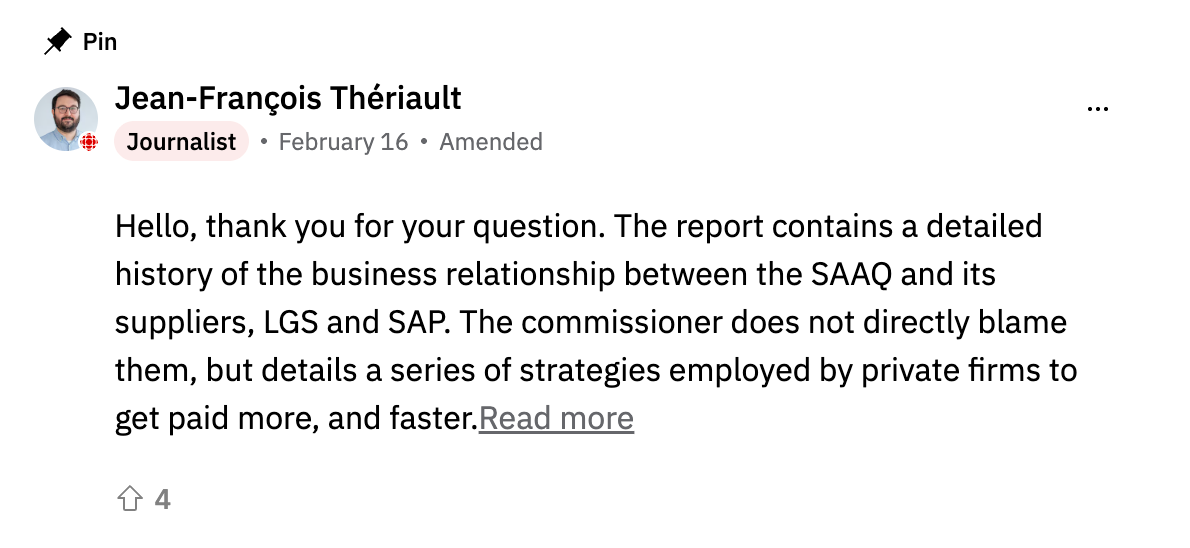
Interestingly, this PSI instance can be directly compared with a third-party moderation company’s comments section on the same subject. The out-sourced moderation service’s comments tended to be shorter and more negative than the PSI discussion.
The journalist, Jean-Francois Theriault, concluded that the PSI toolkit allowed him to enrich his coverage, go deeper in response to real citizens’ concerns, and actually explore new avenues of investigation raised by users. One commenter thanked Theriault for offering a clarification on his previous comment. Theriault also produced a subsequent explainer video to provide the audience greater clarity on the complexity and stakes involved in the SAAQ inquiry.
Higher Quality Conversations
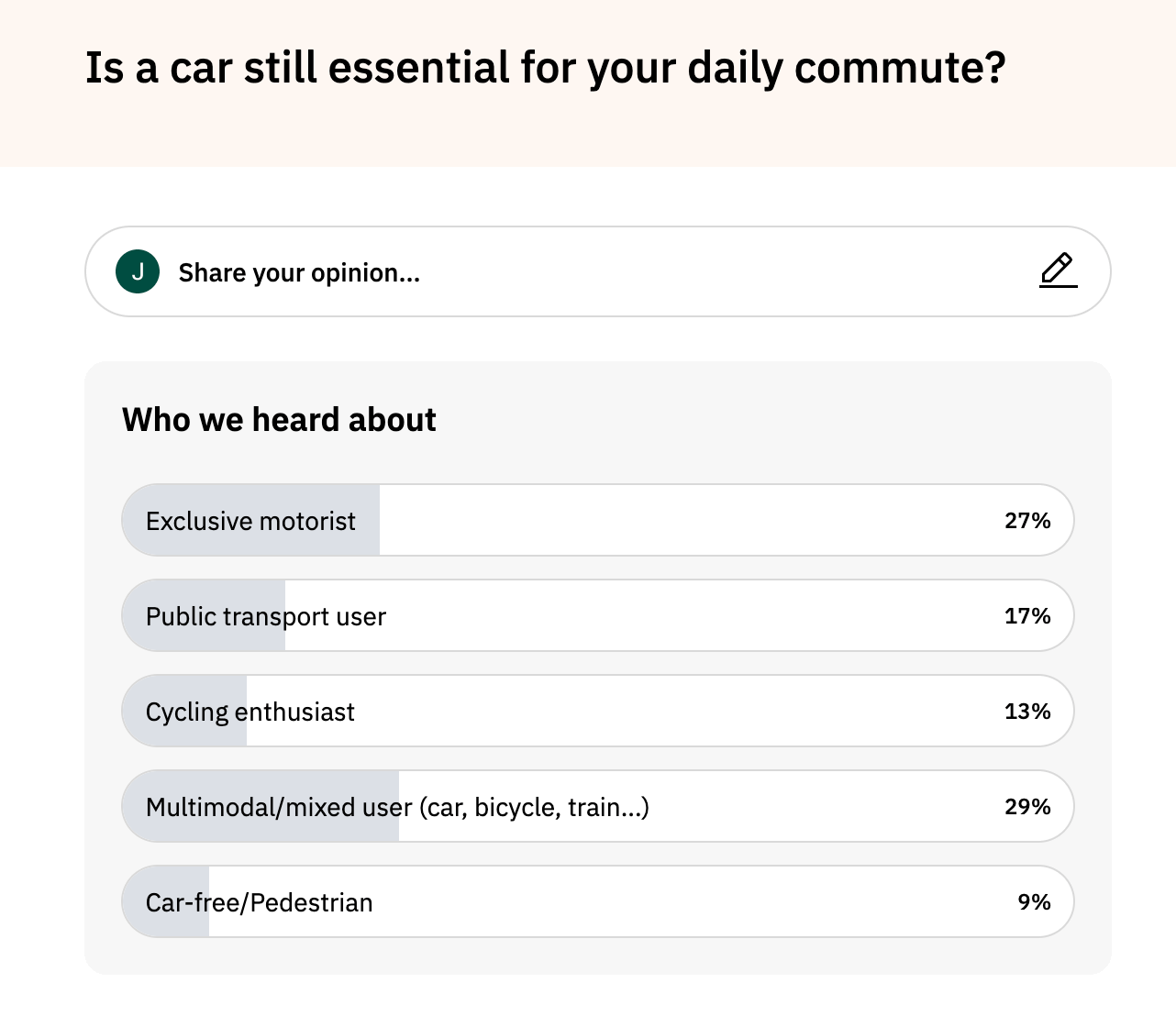
In Belgium, RTBF launched a conversation series alongside its show “Let’s Talk About Solutions” to invite viewers / listeners to engage on topics of civic interest such as employment, housing, and commuting. RTBF posed the question, “Is your car indispensable?” and the audience responded with a wide range of points of view on the challenges of public transportation. By framing the conversation with a question, the audience is primed to respond thoughtfully rather than to simply express their feelings of frustration, or even hostility, regarding the issue.
In most cases, the broadcasters utilize multiple entry points into a conversation, from a button saying “Join the Conversation” on multiple online articles, or QR codes on TV shows pointing to a live PSI conversation. Users can upvote questions they’d like answered; they can situate their position on a “comments slider” that offers a scale rather than a binary choice on a particular issue; or they can participate in a poll on an issue. The goal is the same: higher quality conversation, and more nuanced and respectful conversation.
Perhaps the most touching example of the PSI toolkit in action was a public conversation that occurred during the Artemis II lunar space mission earlier this spring. Audience members of Radio-Canada were invited to ask their questions regarding the mission and they were answered by a variety of leading journalists from the public broadcaster.
Over 1200 audience members participated, with one standing out as the most memorable: “Hello, where is the capsule’s door? Which way will the astronauts exit? Beatrice, 10 years old”
In response, Radio-Canada journalist Catherine Legault described the exact location of the exit and how it would be used when the astronauts came home. As a believer in public service media as an underpinning of our democracy, this exchange between a 10-year-old and her public broadcaster provokes a heart-swelling moment of optimism.
For years we have heard that younger audiences have abandoned legacy media for social media feeds rife with misinformation. The Reuters Institute report on how the majority of younger audiences find their news and information — mostly on social media platforms — is chilling for career journalists trained in the principles of trustworthy and accountable newsgathering and reporting. But if Beatrice has joined the conversation about an important global news event on her local public media platform, then not all is lost!
There is no doubt that healthy democracies depend on open and safe public debate, free from violence and hate. The work of New_ Public and its partner public broadcasters is important because the PSI tools respond to a real world problem: how do we reverse the decline of healthy public conversations in digital spaces? And how do we build new muscles in our journalism and news organizations to engage audiences, younger audiences, in civil online exchange?
In fact, in my opinion, I would go one step further: can these PSI tools be integrated into the apps and websites of other traditional media organizations and other public institutions (libraries, museums, government agencies, universities)? All public institutions are struggling to connect with the public and to engage in healthy and productive online conversations with their constituents. To date, the PSI toolkit has been tested on sites that the public media partners own and operate. I think that the next milestone is to imagine how to ensure that it is available more broadly through an open-source solution.
As entrepreneurs innovate new forms of social media on open, interoperable protocols, I think that public media should be at the forefront. That’s why it was heartening to see ZDF, one of our PSI partners in Germany, sponsor the Open Social Awards. As the world turns away in horror at the degraded experience of the social platforms that were supposed to democratize the world, introducing public media to a new open prosocial web would be a welcome solution.
–Catherine Tait, Expert-in-Residence, New_ Public
Thanks Catherine!
Enjoying the slightly cooler very hot days,
–Josh
 | A guest post by
|